Sightseeing
Hoher Dom Mariä Heimsuchung
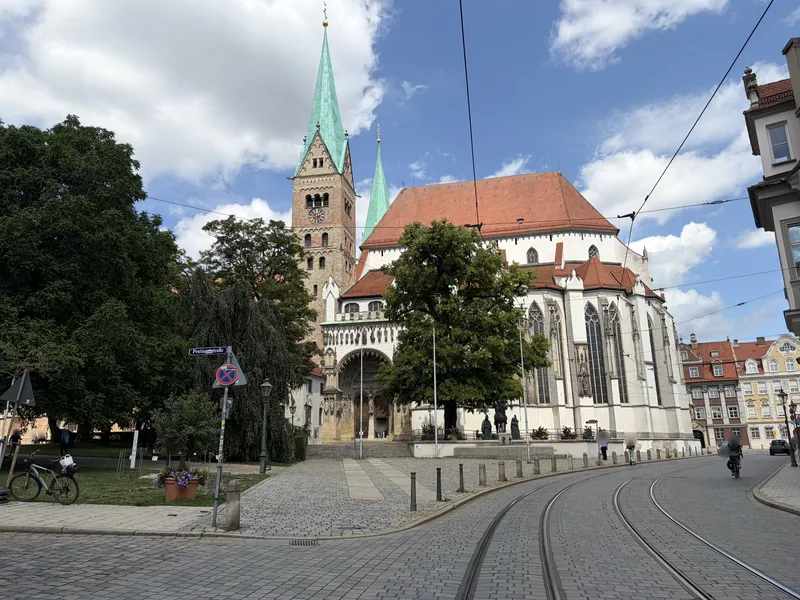 © Visit Augsburg • visitaugsburg.info · CC BY 4.0
Hoher Dom Mariä Heimsuchung is the bishop’s church of the Diocese of Augsburg. Its beginnings go back to the 8th century, and the present building dates from 995 onwards. Inside hang stained-glass windows regarded as the oldest surviving large-scale figurative windows in the world.
At a glance
Ottonian new building from 995, Gothic east choir from 1356 to 1431. The cathedral is 113 m long and its towers are 62 m high. It is open daily from about 7 am to 6 pm, and admission is free.
Visiting and services
The cathedral is open every day. Sightseeing is not possible during services.
- Open daily from about 7 am to 6 pm, admission is free
- Sundays: 7:30 am early Mass, 9:00 am Cathedral Chapter Mass, 10:30 am parish service, 11:30 am Cathedral Preacher’s Mass
- Weekdays: Mass at 7:00 am and 9:30 am
- On feast days: pontifical Masses with the bishop, usually at 10:30 am
No sightseeing during Mass
Plan your visit outside of services. It is quietest on weekdays between the two Masses.
History
No major fire is recorded. The cathedral was rebuilt after a collapse, later remodelled several times and only lightly damaged in the war in 1944.
- 1 8th century: first cathedral buildings under Bishops Wikterp and Simpert, the bishop’s church is consecrated in 805.
- 2 994: the west building collapses. Bishop Liutold begins the new building with the support of Empress Adelheid.
- 3 Around 1000: the transept of the Ottonian cathedral is finished, the nave follows in the first decade of the 11th century.
- 4 From 1331: Gothic remodelling with double side aisles and ribbed vaults.
- 5 1356 to 1431: the Gothic east choir is built, the interior is completed in 1450.
- 6 1537 to 1548: Protestant iconoclasts destroy parts of the furnishings.
- 7 1655 to 1863: the interior is remodelled first in the Baroque, then in the Neo-Gothic style.
- 8 1944: in an air raid around 70 bombs hit the cathedral, but thanks to the fire watch the damage stays light.
- 9 1979 to 1984: the double crypt is reconstructed and the interior comprehensively restored.
Architecture
The cathedral is a five-aisled basilica with two choirs: a single-aisle west choir with a transept and a Gothic east choir with an ambulatory. Under each choir lies a crypt.
- Length 113.25 m, nave width 38.70 m, central nave 17.80 m high
- East choir 28 m high, towers 62 m high
- Romanesque towers of quarry stone, raised in 1487 (south) and 1565 (north)
- Double crypt with a Romanesque east crypt from the middle of the 12th century
- South portal from around 1356 with Heinrich Parler’s master’s mark and scenes of Mary in the tympanum
- Cloister from 1470 to 1510 with 401 tombs and epitaphs
Art treasures
The Prophet Windows
Five windows in the clerestory show David, Daniel, Jonah, Hosea and Moses. They were made at the end of the 11th or the beginning of the 12th century and are regarded as the oldest surviving large-scale figurative stained glass in the world.
The Romanesque bronze door
The reliefs of the 11th-century door show biblical and mythological figures. Since 2002 the original has been on display in the neighbouring Diözesanmuseum St. Afra. A new bronze portal by Max Faller has hung at the choir since 2001.
Holbein panels and Ecce Homo
In 1493 Hans Holbein the Elder painted scenes from the life of Mary. In 1630/31 Georg Petel created the Ecce Homo sculpture, which is influenced by the style of Rubens.
Marian chapel, nativity scene and Holy Sepulchre
The Marian chapel of 1720/21 goes back to Gabriel de Gabrieli. The cathedral’s nativity scene dates from around 1580. In Holy Week the Holy Sepulchre is set up in the chapel.
Organs, bells and music
Two organs and eight bells shape the sound of the cathedral.
- Marienorgel of 1904 with 36 stops, built by Franz Borgias Maerz
- Magnifikat-Orgel of 1988 with 42 stops, built by Rudolf Kubak
- Two silver bells from the 11th century in the north tower, rung by hand
- The Domsingknaben were re-founded in 1976, choirboys have existed in Augsburg since 1439
Location
Close by are the Diözesanmuseum St. Afra with the cathedral treasury and bronze door, the cloister with 401 tombs and the cathedral forecourt with its fountain.